
Auto Degating for Plastic Injection Mold
Auto degating in plastic injection molding refers to the automatic removal of the gate from the molded part during mold opening or ejection. For engineering teams, this means less manual handling, better cycle-to-cycle consistency, and a more scalable approach to plastic injection mold automation for high-volume production.
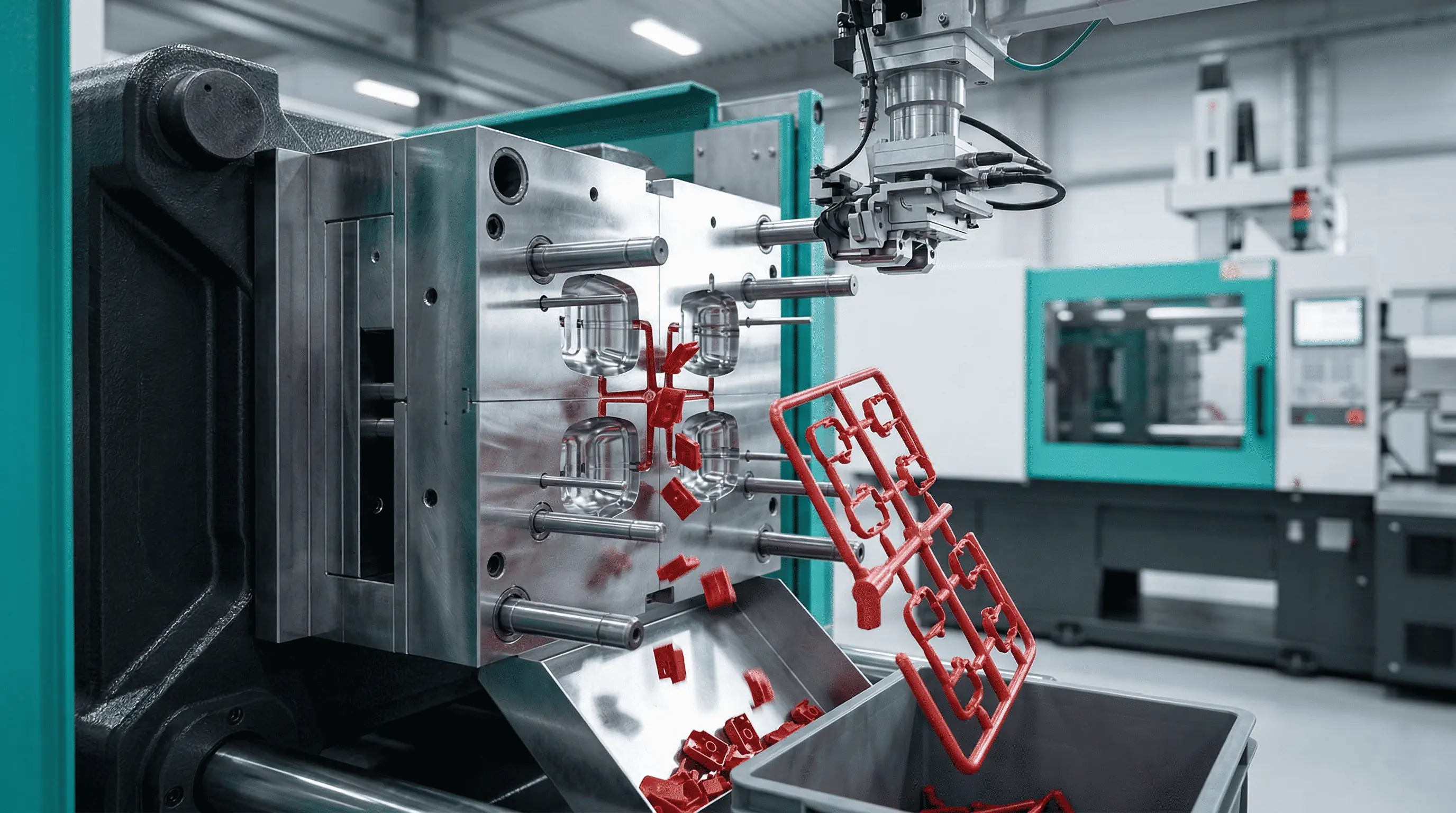
What is Degating in Injection Molding
Degating is the process of separating the molded part from the gate and runner after filling. In conventional molding, this step may be performed manually by operators using hand tools or trimming fixtures. In automated production, the objective is to design the mold so the part is cleanly separated as part of the molding cycle.
From an engineering perspective, the degating system injection molding approach must consider resin behavior, gate position, wall thickness, ejection direction, and acceptable vestige. These factors determine whether a manual trimming process is necessary or whether an automatic degating mold can be used reliably.
Manual vs Automatic Degating
Manual Degating
- Operator removes gate after molding using cutters or trimming tools
- Common for complex parts or when gate vestige tolerance is tight
- Higher labor input and greater dependence on operator consistency
- May be acceptable for low-volume or highly cosmetic parts
Automatic Degating
- Gate is separated during mold opening, ejection, or downstream automation
- Supports auto degating injection molding for repeatable production
- Reduces handling variation and improves production flow
- Best suited for programs that justify self degating mold design
How Auto Degating Works (Design Concepts)
Auto degating injection molding depends on geometry and controlled separation. The mold is designed so that during opening or ejection, the gate breaks predictably at the intended section without damaging the part. This is why the gate type, gate land dimensions, runner layout, and opening sequence all matter.
A self degating mold design often uses directional stress at the gate to force clean separation. For example, a tunnel gate can shear the gate automatically during ejection, while a 3-plate mold structure can separate runner and part during mold opening. In more advanced cells, robotic handling may remove parts and runners as part of a broader plastic injection mold automation strategy.
- Gate position must support controlled break-off without deforming the part
- Runner and part release timing must be predictable across repeated cycles
- Material selection affects gate vestige, shear response, and break consistency
- Mold maintenance is important to preserve degating performance over time
Types of Auto Degating Solutions
Tunnel Gate
A tunnel gate, also called a submarine gate, feeds material below the parting line and is designed to shear automatically when the part is ejected. It is widely used when a compact gate location and automatic separation are required.
3-Plate Mold Structure
A 3-plate mold structure creates a separate opening sequence for runner and part, allowing the gate to detach during mold opening. This design is often selected when gate location needs to be optimized for filling but the process still requires an automatic degating mold solution.
Robotic Degating
For parts that cannot fully self-degate within the mold, robotic degating may be integrated after ejection. This can include pick-and-place units, cutters, or automated trimming stations that extend the degating system injection molding workflow beyond the tool itself.
Benefits of Auto Degating
- Reduce labor cost by removing or minimizing manual trimming steps
- Improve consistency by controlling how the gate separates each cycle
- Increase production efficiency through faster cycle completion and less handling
- Support cleaner process flow for high-volume manufacturing cells
- Lower dependence on operator skill for gate removal quality
- Enable better integration with downstream inspection, packing, or robotic handling
Before and After Auto-Degating Examples
The following examples show molded products before and after applying an auto-degating solution. These comparisons help illustrate how automatic gate separation can reduce visible gate remnants, minimize manual finishing, and support a more consistent production result.
Example 1: Rectangular cover component
This comparison highlights how the auto-degating solution removes the need for a large visible gate remnant and leaves a cleaner molded surface.
Example 2: Bracket-style molded part
The part geometry shows how a self-degating approach can separate the molded component from the runner more cleanly during the molding cycle.
Example 3: Long trim component
For larger linear parts, auto degating helps reduce secondary trimming work and supports more consistent output across repeated cycles.
Example 4: Frame-shaped component
This example demonstrates how the gate and runner layout can be managed so the finished frame is separated more efficiently during mold opening or ejection.
Example 5: Hinged housing panel
For cosmetic exterior parts, an automatic degating mold concept can reduce manual finishing effort while helping maintain repeatable gate break quality.
Example 6: Rounded cover component
This sample shows how auto degating can improve presentation on visible surfaces by controlling where the gate is separated from the final molded part.
Applications & Industries
- Consumer electronics parts that require stable output and repeatability
- Automotive plastic components produced in medium to high volumes
- Medical and laboratory device housings where process control is important
- Industrial connectors, covers, and small molded precision parts
- Programs where procurement teams are targeting automation-driven cost savings
When evaluating an automatic degating mold approach, engineering teams usually review both mold cost and long-term production cost. For many programs, the added design effort is justified when labor reduction, consistency, and throughput improvements are considered together.
Why Choose Octagon Precision Mold
- Understanding of mold design factors that influence degating performance and manufacturability
- Support for technical review of gate selection, runner concepts, and production practicality
- Experience in precision mold-related manufacturing and component support
- Suitable for B2B customers looking for practical engineering discussion rather than generic sales claims
- Capability to support mold-related enquiries for Malaysia and international industrial customers
Related Resources
FAQ
Is auto degating suitable for every injection molded part?
No. Part geometry, gate location, cosmetic requirements, resin type, and vestige tolerance all affect whether auto degating is practical. Some parts still require manual or robotic trimming.
What is the difference between a tunnel gate and a 3-plate mold for degating?
A tunnel gate typically shears the gate during ejection, while a 3-plate mold uses a separate opening action to detach the runner and gate during mold opening. The right choice depends on part design and gating requirements.
Why do procurement teams consider automatic degating mold concepts?
Procurement teams often evaluate automatic degating because it can reduce direct labor, improve process consistency, and support better production efficiency over the lifetime of a mold program.
View our catalogue
Review our available product references and supporting materials related to mold systems and industrial manufacturing.
View our catalogueContact us for mold design consultation
If you are evaluating self degating mold design, runner concepts, or broader plastic injection mold automation options, share your part details or tooling requirements with Octagon Precision Mold. We support technical discussions for engineers, mold designers, and procurement teams.
Contact us for mold design consultation